Sunday, March 30, 2014

# 12


                History of Bosnia and Herzegovina


         Sloboda za Bosnu!    Freedom for Bosnia!


 Kingdom of Bosnia


The Ottoman conquest of Bosnia marked a new era in the country's history and introduced tremendous changes in the political and cultural landscape of the region.
Although the kingdom had been crushed and its high nobility executed, the Ottomans nonetheless allowed for the preservation of Bosnia's identity by incorporating it as an integral province of the Ottoman Empire with its historical name and territorial integrity - a unique case among subjugated states in the Balkans. Within this sandžak (and eventual vilayet) of Bosnia, the Ottomans introduced a number of key changes in the territory's socio-political administration; including a new landholding system, a reorganization of administrative units, and a complex system of social differentiation by class and religious affiliation.
The four centuries of Ottoman rule also had a drastic impact on Bosnia's population make-up, which changed several times as a result of the empire's conquests, frequent wars with European powers, migrations, and epidemics.
A native Slavic-speaking Muslim community emerged and eventually became the largest ethno-religious group (mainly as a result of a gradually rising number of conversions to Islam), while a significant number of Sephardi Jews arrived following their expulsion from Spain in the late 15th century.
The Bosnian Christian communities also experienced major changes. The Bosnian Franciscans (and the Catholic population as a whole) were protected by official imperial decree, although on the ground these guarantees were often disregarded and their numbers dwindled.
The Orthodox community in Bosnia, initially confined to Herzegovina and southeastern Bosnia, spread throughout the country during this period and went on to experience relative prosperity until the 19th century.
Meanwhile, the native schismatic Bosnian Church disappeared altogether.
As the Ottoman Empire thrived and expanded into Central Europe, Bosnia was relieved of the pressures of being a frontier province and experienced a prolonged period of general welfare and prosperity.
A number of cities, such as Sarajevo and Mostar, were established and grew into major regional centers of trade and urban culture.
Within these cities, various Sultans and governors financed the construction of many important works of Bosnian architecture (such as the Stari most and Gazi Husrev-beg's Mosque).
Furthermore, numerous Bosnians played influential roles in the Ottoman Empire's cultural and political history during this time.
Bosnian soldiers formed a large component of the Ottoman ranks in the battles of Mohács and Krbava field, two decisive military victories, while numerous other Bosnians rose through the ranks of the Ottoman military bureaucracy to occupy the highest positions of power in the Empire, including admirals, generals, and grand viziers.
Many Bosnians also made a lasting impression on Ottoman culture, emerging as mystics, scholars, and celebrated poets in the Turkish, Arabic, and Persian languages.


Bosnian Revolt Flag, 1831


By the late 17th century, however, the Ottoman Empire's military misfortunes caught up with the country, and the conclusion of the Great Turkish War with the Treaty of Karlowitz in 1699 once again made Bosnia the empire's westernmost province. But they allowed some of the Bosnian tribes for example the Hajaliic tribe (now Bushnaq family) to immigrate into the Arabian countries (Palestine, Jordan).
The following hundred years were marked by further military failures, numerous revolts within Bosnia, and several outbursts of plague.
The Porte's efforts at modernizing the Ottoman state were met with great hostility in Bosnia, where local aristocrats stood to lose much through the proposed reforms.
This, combined with frustrations over political concessions to nascent Christian states in the east, culminated in a famous (albeit ultimately unsuccessful) revolt by Husein Gradaščević in 1831.
Related rebellions would be extinguished by 1850, but the situation continued to deteriorate.
Later, agrarian unrest eventually sparked the Herzegovinian rebellion, a widespread peasant uprising, in 1875.
The conflict rapidly spread and came to involve several Balkan states and Great Powers, which eventually forced the Ottomans to cede administration of the country to Austria-Hungary through the Treaty of Berlin in 1878.


 Occupation by Austria-Hungary (1878–1918)


Though an Austria-Hungary military force quickly subjugated initial armed resistance upon take-over, tensions remained in certain parts of the country (particularly Herzegovina) and a mass emigration of predominantly Muslim dissidents occurred.
However, a state of relative stability was reached soon enough and Austro-Hungarian authorities were able to embark on a number of social and administrative reforms which intended to make Bosnia and Herzegovina into a "model colony".
With the aim of establishing the province as a stable political model that would help dissipate rising South Slav nationalism, Habsburg rule did much to codify laws, to introduce new political practices, and generally to provide for modernization.


First stamp (1879) of Bosnia and Herzegovina under Austria-Hungary administration. Note the absence of name, to avoid ethnic problems.
 
Although successful economically, Austro-Hungarian policy - which focused on advocating the ideal of a pluralist and multi-confessional Bosnian nation (largely favored by the Muslims) - failed to curb the rising tides of nationalism.
The concept of Croat and Serb nationhood had already spread to Bosnia and Herzegovina's Catholics and Orthodox communities from neighboring Croatia and Serbia in the mid 19th century, and was too well-entrenched to allow for the widespread acceptance of a parallel idea of Bosnian nationhood.
By the latter half of the 1910s, nationalism was an integral factor of Bosnian politics, with national political parties corresponding to the three groups dominating elections.
The idea of a unified South Slavic state (typically expected to be spearheaded by independent Serbia) became a popular political ideology in the region at this time, including in Bosnia and Herzegovina.
The Austro-Hungarian government's decision to formally annex Bosnia-Herzegovina in 1908 (the Bosnian Crisis) added to a sense of urgency among these nationalists.
The political tensions caused by all this culminated on 28 June 1914, when Serb nationalist youth Gavrilo Princip assassinated the heir to the Austro-Hungarian throne, Archduke Franz Ferdinand, in Sarajevo; an event that proved to be the spark that set off World War I.
Although 10% of the Bosniak population died serving in the armies or being killed by the various warring states, Bosnia and Herzegovina itself managed to escape the conflict relatively unscathed.


               EUROPE IN 1900


Husein Gradaščević
Husein Gradaščević.jpg
 
         The Dragon of Bosnia
(1802

Husein-kapetan Gradaščević

(31 August 1802 – 17 August 1834)

was a Bosniak general who fought against the Ottoman Empire and new reforms implemented by the Sultan Mahmud II which abolished the ayan (landlord) system.
He is often referred to as "Zmaj od Bosne", meaning "the Dragon of Bosnia".
Gradaščević was born in Gradačac in 1802—hence his surname Gradaščević, meaning "of Gradačac"—and grew up surrounded by a political climate of turmoil in the western reaches of the Ottoman Empire. The young Husein developed a reputation for wise rule and tolerance and soon became one of the most popular figures in Bosnia.


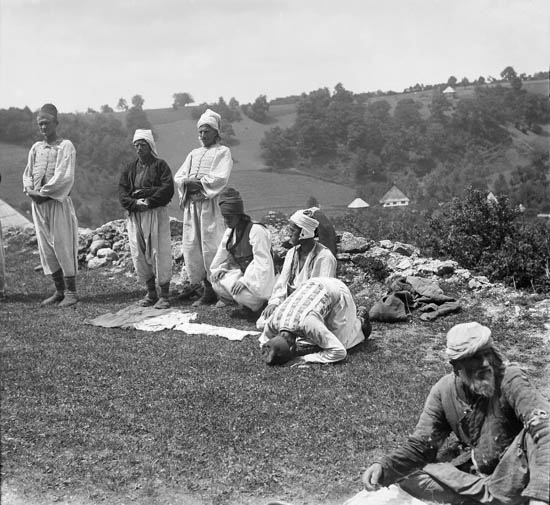
              Bosnian National Costumes

  1. Recent Photos The Commons Getty Collection Galleries World Map App ...
  2. bosnian national costume
  3. il_570xN.414427720_jtrm.jpg
  4. gallery office of world best in republic library an extensive
  5. BOSNIAN NATIONAL COSTUME
  6. bosnias national costumes are rest of wir bieten westernreituntericht ...
  7. Croatian national costumes in Bosnia and Herzegovina, part 4


File:Bruner-Dvorak, Rudolf - Bosna, modlitba (ca 1906).jpg

Gdje ti mnogo obećavaju, malu torbu ponesi.


Translation: Where people are promising much to you, bring a small bag.


Thanks to Wiki.

Sunday, March 23, 2014

# 11


Thucydides took lunch with Isaiah at a local café. After ordering their favorite meal and wine, Thucy asked Isa what he thought about the Balkan story.


"I'm glad you asked me that. I added, a few years back, a good prophecy to my 19th verse that might answer your query. Do you want to hear it?”


“Yes, indeed I would.”


See the Lord rides on a swift cloud and is coming to Egypt. The idols of Egypt tremble before him, and the hearts of the Egyptians melt with fear. ‘I will stir up Egyptian against Egyptian—brother will fight against brother, neighbor against neighbor, city against city, kingdom against kingdom. The Egyptians will lose heart, and I will bring their plans to nothing…’”


“But Isa, what has that got to do with the Balkans?”


“Change "Egypt" to “Ottoman” and we can predict the history of the Balkans.”


The two men clicked their wine glasses together.


History Of Albania


The history of Albania emerges from prehistoric stage 3000 BC, with early records of Illyria in Greco-Roman historiography.
The modern territory of Albania has no counterpart in antiquity, comprising parts of the Roman provinces of Dalmatia (southern Illyricum), Macedonia (particularly Epirus Nova), and Moesia Superior.
The territory remained under Roman (Byzantine) control until the Slavic migrations of the 7th century, and was integrated into the Bulgarian Empire in the 9th century.

The territorial nucleus of the Albanian state formed in the Middle Ages, as the Principality of Arbër and the Sicilian dependency known as the Kingdom of Albania.

The first records of the Albanian people as a distinct ethnicity also date to this period.
The area was part of the Serbian Empire, passing to the Ottoman Empire in the 15th century. It remained under Ottoman control as part of Rumelia province until 1912, when the first independent Albanian state was declared.


Ottoman Rule (1481-1912)


Ottoman supremacy in the west Balkan region began in 1385 with the Battle of Savra.
On the conquered part of Albania, which territory stretched between Mat River on the north and Çameria to the south, Ottoman Empire established the Sanjak of Albania and in 1419 Gjirokastra became the county town of the Sanjak of Albania.
 
Beginning in the late-14th century, the Ottomans expanded their empire from Anatolia to the Balkans (Rumelia).

By the 15th century, the Ottomans ruled most of the Balkan Peninsula. Their advance in Albania was interrupted in the 15th century, when George Kastrioti Skanderbeg, the Albanian national hero who had served as an Ottoman military officer, renounced Ottoman service, allied with some Albanian chiefs forming the League of Lezhë and fought off successfully Turkish rule from 1443–1468 upon his death.
Three major attacks (Siege of Krujë (1450), Second Siege of Krujë (1466–67), Third Siege of Krujë (1467)) suffered Albania during this period from major armies led by the great Ottoman sultans themselves, Murad II and Mehmed II The Conqueror.
Albania was almost fully re-occupied by the Ottomans in 1479 after capturing Shkodër from Venice. Albania's conquest by Ottomans was completed after Durrës's capture from Venice in 1501.


Ottoman-Albanian wars


Many Albanians had been recruited into the Janissary, including the feudal heir George Kastrioti who was renamed Skanderbeg (Iskandar Bey) by his Turkish trainers at Edirne. After some Ottoman defeats at the hands of the Hungarians, Skanderbeg deserted on November 1443 and began a rebellion against the Ottoman Empire.

After deserting, Skanderbeg re-converted to Roman Catholicism and declared war against the Ottoman Empire, which he led from 1443 to 1468.

Under a red flag bearing Skanderbeg's heraldic emblem, an Albanian force held off Ottoman campaigns for twenty-five years and overcame sieges of Krujë led by major forces of the Ottoman sultans Murad II and Mehmed II.
However, Skanderbeg was unable to receive any of the help which had been promised him by the popes or the Italian states, Venice, Naples and Milan. He died in 1468, leaving no worthy successor.

After his death the rebellion continued, but without its former success. The loyalties and alliances created and nurtured by Skanderbeg faltered and fell apart and the Ottomans reconquered the territory of Albania, culminating with the siege of Shkodra in 1479.
Shortly after the fall of the castles of northern Albania, many Albanians fled to neighboring Italy, giving rise to the modern Arbëreshë communities.


Late Ottoman period


Upon the Ottomans' return in 1479, a large number of Albanians fled to Italy, Egypt and other parts of the Ottoman Empire and Europe and maintained their Arbëresh identity.
Many Albanians won fame and fortune as soldiers, administrators, and merchants in far-flung parts of the Empire.
As the centuries passed, however, Ottoman rulers lost the capacity to command the loyalty of local pashas, which threatened stability in the region.
The Ottoman rulers of the 19th century struggled to shore up central authority, introducing reforms aimed at harnessing unruly pashas and checking the spread of nationalist ideas.
Albania would be a part of the Ottoman Empire until the early 20th century.

The Ottoman period that followed was characterized by a change in the landscape through a gradual modification of the settlements with the introduction of bazaars, military garrisons and mosques in many Albanian regions.
Part of the Albanian population gradually converted to Islam, with many joining the Sufi Order of the Bektashi.
 Converting from Christianity to Islam brought considerable advantages, including access to Ottoman trade networks, bureaucratic positions and the army.
As a result many Albanians came to serve in the elite Janissary and the administrative Devşirme system. Among these were important historical figures, including Iljaz Hoxha, Hamza Kastrioti, Koca Davud Pasha, Zağanos Pasha, Köprülü Mehmed Pasha (head of the Köprülü family of Grand Viziers), the Bushati family, Sulejman Pasha, Edhem Pasha, Nezim Frakulla, Ali Pasha of Tepelena, Haxhi Shekreti, Hasan Zyko Kamberi, Ali Pasha of Gucia, Mehmet Ali ruler of Egypt[35] and Emin Pasha.

Many Albanians gained prominent positions in the Ottoman government, Albanians highly active during the Ottoman era and leaders such as Ali Pasha of Tepelena might have aided Husein Gradaščević.
The Albanians proved generally faithful to Ottoman rule following the end of the resistance led by Skanderbeg, and accepted Islam more easily than their neighbors.
No fewer than 42 Grand Viziers of the Empire were of Albanian descent. The Ottoman period also saw the rising of semi-autonomous Albanian ruled Pashaliks and Albanians were also an important part of the Ottoman army and Ottoman administration like the case of Köprülü family.
Albania would remain a part of the Ottoman Empire as the provinces of Scutari, Monastir and Janina until 1912.


Birth of nationalism


However, in the 19th century after the fall of the Albanian pashaliks and the Massacre of the Albanian Beys an Albanian National Awakening took place and many revolts against the Ottoman Empire were organized.
Such revolts included the Albanian Revolts of 1833-1839, the Revolt of 1843–44, and the Revolt of 1847.
A culmination of the Albanian National Awakening were the League of Prizren and the League of Peja, but they were unsuccessful to an Albanian independence, which occurred only in 1912, through the Albanian Declaration of Independence.


NATIONAL HEROES


                  George Kastrioti Skanderbeg
Dominus Albaniae (Lord of Albania)

Gjergj Kastrioti.jpg

Portrait of Skanderbeg in the Uffizi, Florence


Yanitza, Albanian Joan of Arc - Illustration of 1911


Baca Kurti Gjokaj

Abdyl be Frasheri

Abdyl bey Frashëri
Chairman of the Albanian Committee 1877


Bajram Curri

Albanian Traditional Costumes


                                     http://www.donaldbrittonconrad.com/


Monday, March 17, 2014

#10


The Ottoman Empire
 

Acele işe şeytan karişir!


The   Devil  interferes  with  hurried  work.


A Child's View of: The Ottoman Empire Declines


By 1600 A.D., the Ottoman Empire had reached its height. Istanbul was among the most prosperous and beautiful cities on Earth. They had conquered vast stretches of territory, and had learned to rule it successfully.

From this point on, the empire gradually began to decline.
In 1683, King John III Sobieski from Poland led his armies in defeating the armies of the Ottomans in Vienna. This crushing defeat marked the end of the expansion of the Ottoman Empire.
 
King John III Sobieski's army defeats the Turks.
 King John III Sobieski of Poland
 
In 1856, Sultan Abdul-Mejid I attempted to reform his empire in an effort to save it. He issued a decree known as the Hatt-I Humayun. This decree granted the rights of citizenship to everyone living within the empire, and attempted to create more freedoms for all his people, while improving economic growth.
These efforts were unsuccessful and eventually led to his son being overthrown. Within just a few years the Ottoman Empire would collapse.


The Ottoman Empire

(Ottoman Turkish: دَوْلَتِ عَلِيّهٔ عُثمَانِیّه Devlet-i Aliyye-i Osmâniyye, Turkish: Osmanlı İmparatorluğu),
 
sometimes referred to as the Turkish Empire or simply Turkey, was an empire founded by Oghuz Turks under Osman Bey in north-western Anatolia in 1299.
With the conquest of Constantinople by Mehmed II in 1453, the Ottoman state was transformed into a transcontinental hyperpower.
 
During the 16th and 17th centuries, in particular at the height of its power under the reign of Suleiman the Magnificent, the Ottoman Empire was one of the most powerful states in the world – a multinational, multilingual empire, controlling much of Southeast Europe, Western Asia, the Caucasus, North Africa and the Horn of Africa.
At the beginning of the 17th century the empire contained 32 provinces and numerous vassal states, some of which were later absorbed into the empire, while others were granted various types of autonomy during the course of centuries.
With Constantinople as its capital and control of vast lands around the Mediterranean basin, the Ottoman Empire was at the centre of interactions between the Eastern and Western worlds for over six centuries.
It was dissolved in the aftermath of World War I; the collapse of the empire led to the emergence of the new political regime in Turkey itself, as well as the creation of modern Balkan and Middle Eastern states.
 

                                                         NAME

The word "Ottoman" is a historical Anglicisation of the name of Osman I, the founder of the Empire and its sole ruling dynasty, the House of Osman (also known as the Ottoman dynasty).
In Ottoman Turkish, the empire was referred to as Devlet-i ʿAliyye-yi ʿOsmâniyye or alternatively Osmanlı Devleti (عثمانلى دولتى).
In Modern Turkish, it is known as Osmanlı İmparatorluğu ("Ottoman Empire") or Osmanlı Devleti ("The Ottoman State").
In some Western accounts, the two names "Ottoman" and "Turkey" were often used interchangeably.
This dichotomy was officially ended in 1920–23, when the Ankara-based Turkish regime favoured Turkey as a sole official name, which had been one of the European names of the state since medieval times.

HISTORY


Rise (1299–1453)


Upon the demise of the Turkish Seljuk Sultanate of Rum, precursor of Ottomans, in 1300s, Anatolia was divided into a patchwork of independent, mostly Turkish states, the so-called Ghazi emirates.
One of the Ghazi emirates was led by Osman I (1258 – 1326), from which the name Ottoman is derived. Osman I extended the frontiers of Turkish settlement toward the edge of the Byzantine Empire.
It is not well understood how the Osmanli came to dominate their neighbours, as the history of medieval Anatolia is still little known.

In the century after the death of Osman I, Ottoman rule began to extend over the Eastern Mediterranean and the Balkans.

The Ottoman victory at Kosovo in 1389 effectively marked the end of Serbian power in the region, paving the way for Ottoman expansion into Europe.

Another army (of Hungarian and Wallachian forces) attacked the Turks, but was again defeated by Murad II at the Second Battle of Kosovo in 1448.

In the 15th and 16th centuries, the Ottoman Empire entered a period of expansion. The Empire prospered under the rule of a line of committed and effective Sultans. It also flourished economically due to its control of the major overland trade routes between Europe and Asia.


EmperorSuleiman.jpg

Suleiman the Magnificent (1520–1566)
 
Sulieman the Magnificent captured Belgrade in 1521, conquered the southern and central parts of the Kingdom of Hungary as part of the Ottoman–Hungarian Wars, and, after his historical victory in the Battle of Mohács in 1526, he established Turkish rule in the territory of present-day Hungary (except the western part) and other Central European territories.
He then laid siege to Vienna in 1529, but failed to take the city.
 In 1532, he made another attack on Vienna, but was repulsed in the Siege of Güns.
Transylvania, Wallachia and, intermittently, Moldavia, became tributary principalities of the Ottoman Empire.
In the east, the Ottoman Turks took Baghdad from the Persians in 1535, gaining control of Mesopotamia and naval access to the Persian Gulf.

By the end of Suleiman's reign, the Empire's population totaled about 15,000,000 people extending over three continents.
Plus, the Empire became a dominant naval force, controlling much of the Mediterranean Sea.


Revolts and Revival (1566–1683)


The effective military and bureaucratic structures of the previous century came under strain during a protracted period of misrule by weak Sultans. The Ottomans gradually fell behind the Europeans in military technology as the innovation that fed the Empire's forceful expansion became stifled by growing religious and intellectual conservatism.
But in spite of these difficulties, the Empire remained a major expansionist power until the Battle of Vienna in 1683, which marked the end of Ottoman expansion into Europe.

The conquest of Crete completed in 1669 and expansion into Polish southern Ukraine, with the strongholds of Khotyn and Kamianets-Podilskyi and the territory of Podolia ceding to Ottoman control in 1676.

This period of renewed assertiveness came to a calamitous end in May 1683 when Grand Vizier Kara Mustafa Pasha led a huge army to attempt a second Ottoman siege of Vienna in the Great Turkish War of 1683–1687. The final assault being fatally delayed, the Ottoman forces were swept away by allied Habsburg, German and Polish forces spearheaded by the Polish king Jan III Sobieski at the Battle of Vienna.
The alliance of the Holy League pressed home the advantage of the defeat at Vienna, culminating in the Treaty of Karlowitz (26 January 1699), which ended the Great Turkish War.
The Ottomans surrendered control of significant territories, many permanently.

The Austro-Russian–Turkish War, which was ended by the Treaty of Belgrade in 1739, resulted in the recovery of Serbia and Oltenia, but the Empire lost the port of Azov to the Russians. After this treaty the Ottoman Empire was able to enjoy a generation of peace, as Austria and Russia were forced to deal with the rise of Prussia.


Educational and technological reforms were made, including the establishment of higher education institutions such as the Istanbul Technical University.
 

Decline and Modernization (1828–1908)


During the Tanzimat period (1839–1876), the government's series of constitutional reforms led to a fairly modern conscripted army, banking system reforms, the decriminalisation of homosexuality, the replacement of religious law with secular law and guilds with modern factories.
The Ottoman Ministry of Post was established in Istanbul on 23 October 1840.


Samuel Morse received his first ever patent for the telegraph in 1847, which was issued by Sultan Abdülmecid who personally tested the new invention.

Following this successful test, installation works of the first telegraph line (Istanbul-Adrianople-Şumnu) began on 9 August 1847.


Thanks to:

Wikipedia

&
World History for Kids

http://www.donaldbrittonconrad.com/


Wednesday, March 12, 2014

# 9


History of the Balkans


Republic of Venice


The Republic of Venice controlled areas of the Balkans from the early Middle Ages until 1797.


The Republic of Venice (shown in orange), its possessions and other surrounding states in the 15th and 16th century Balkans.


Venice seized a number of locations on the eastern shores of the Adriatic sea before 1200, partly for purely commercial reasons, but also because pirates based there were a menace to its trade. The Doge since that time bore the titles of Duke of Dalmatia and Duke of Istria.

In building its maritime commercial empire, the Republic dominated the trade in salt, acquired control of most of the islands in the Aegean, including Cyprus and Crete, and became a major "power" in the Near East and in all the Balkans.

Venice became a fully imperial power following the Venetian-financed Fourth Crusade, which in 1203 captured and in 1204 sacked Constantinople and established the Latin Empire. Venice subsequently carved out a sphere of influence in the Aegean known as the Duchy of the Archipelago, and also gained control of the island of Crete.

From the 14th century, Venice controlled most of the maritime commerce of the Balkans with important colonial possessions on the Adriatic and Aegean coasts.

Venice's long decline started in the 15th century, when it first made an unsuccessful attempt to hold Thessalonica against the Ottomans (1423–1430). She also sent ships to help defend Constantinople against the besieging Turks (1453). After the city fell to Sultan Mehmet II, he declared war on Venice. The war lasted thirty years and cost Venice many of the eastern Mediterranean possessions.

Slowly the Republic of Venice lost nearly all possessions in the Balkans, maintaining in the 18th century only the Adriatic areas of Istria, Dalmatia and Albania Veneta. The Venetian island of Corfu was the only area of Greece never occupied by the Turks.

In 1797 Napoleon conquered Venice and caused the end of the Republic of Venice in the Balkans.

                           http://www.donaldbrittonconrad.com/

Sunday, March 9, 2014

# 8


Aha! You thought we were done with the 1st Prussian-Danish War.


One more event. It affected most wars up to now.


Thus from the political point of view, the stormy period which broke out in 1848 had ended with the humiliation of Prussia, and her definite subordination to her rival Austria; and the sense of inferiority was increased by the military setback she had received elsewhere at the hands of a third-rate Power.
The war with Denmark closed with the marked discomfiture of Prussia.
The origin of that contest lies buried in one of the most difficult and complicated questions of European history---that of Schleswig-Holstein, and it might be passed by without remark were it not---as has been truly said---that the conflicts of 1864 and 1866 can no more be understood without a knowledge of that of 1848, than the siege of Troy can be understand without a knowledge of the abduction of Helen.
To use Moltke's words it was "the first link of a chain which led to Nicholsburg an Versailles."

As far back as 1460 the two duchies had been united to the kingdom of Denmark; Holstein, however, has also formed part of the Holy Roman Empire though Schleswig had not; both duchies contained large numbers of inhabitants of German origin who were discontented with their lot; and the Salic law prevailed both in Schleswig and Holstein, but not in Denmark. These ingredients of trouble when thrown into the seething pot of 1848 soon boiled into war.
Several German monarchs, anxious to find a safety-valve, determined to espouse the popular cause of Schleswig-Holstein. The Kings of Prussia and Hanover sent each a division, and a little later the Diet of the German Confederation likewise declared war on Denmark.

Into the details of the struggle, although it forms a study of exceptional interest, it is not necessary to go.
The salient fact was that the Danes had a fleet while the Germans had practically none, and the Danes could move their troops by sea when and where they chose, besides possessing the ability---which they used to the full---of exerting a strict blockade of Prussia's ports.
By the beginning of August the difficulties of the campaign had been brought home to the Prussian general von Wrangel. In a doleful dispatch to the Frankfort Parliament he wrote:

To bring about a peace something more than mere occupation of the enemy's territory is required. The destruction of his army and war material is necessary, and of that, so far as my experience goes, there is no chance. The enemy will continue to avoid battle and to withdraw to the islands under the protection of his ships, and to attack these islands is impossible for a land Power however strong it may be...only by the assistance of an allied fleet will it be possible to compel the enemy to accept battle and to bring about a peace.

The result of the possession by Denmark of islands to which, and of a fleet by which, troops could be transferred at will, brought it about that, although Prussia was the prime mover in the attack on Denmark, by the winter of 1849 she was glad to accept a temporary armistice.
When the campaign was renewed the numerical inferiority of the Danes on land seemed, for the moment, to promise certain victory to Prussia and her allies, but by turning maritime command to most brilliant account the siege of Fredericia was raised by the Danes, and the Germans were completely defeated.
By 1850 the insurgents, abandoned by their German allies, who were intimidated by the attitude of Russia and Austria, laid down their arms. Denmark issued triumphant from the struggle, and had beaten off the onset of a great military Power in two successive campaigns.
The Prussia which had risen like a phoenix from the ashes of Jena, and into whose military decay Scharnhorst and Clausewitz had breathed new life, had been made to seem lath and plaster painted to look like iron.

The political and military humiliation of Prussia had succeeded the outburst of Prussian liberalism; and the liberals had failed chiefly because they had steeped themselves in the error that national aspirations can be won by mere discussion, and without the support of powerful armed forces.

From Moltke

by F. E. Whitton


http://www.donaldbrittonconrad.com/

Wednesday, March 5, 2014

# 7 


 I'll wager that you paid scant attention to my report of the 1st Prussian-Danish war.


For history's sake, let's review it. OK?


The clash came over the Schleswig-Holstein question.
This, one of the most confused of the minor issues of nineteenth century history, haunted the European chancelleries like a nightmare for more than a generation.
But, leaving to one side its many legal complications, it becomes simplicity itself the moment we view it from a national angle.
The united duchies of Schleswig and Holstein occupied the southern half of the peninsula of Jutland and were inhabited, except for the northern rim of Schleswig, which is Danish, by a German population.
By an accident of inheritance the king of Denmark was also duke of Schleswig and Holstein, but the two duchies were in no sense a part of Denmark and lived under their own legal and administrative
system.
This independence of Denmark the two duchies, because they were preponderantly German, were firmly resolved to preserve.

Toward the middle of the century an issue dawned which put the Germans sharply on guard.
The royal house of Denmark, about to die out in the male line, was faced by a constitutional difficulty.
By law of Denmark the crown would descend to a female line, while by the Schleswig-Holstein law, at least as interpreted by the German population, the crown of the united duchies would pass to the nearest male relative.

There was therefore the prospect of an early divorce between Denmark and the duchies which rejoiced the Germans as much as it grieved the Danes.
In 1846, the king of Denmark took the grave step of issuing a public declaration to the effect that, comes what might, he would see to it that the union between Denmark and the duchies should be maintained.

Frederik VII af August Schiøtt.jpg
                                       Frederick VII of Denmark

This royal declaration the German population regarded  as a breach of law and custom.
They were thrown into a revolutionary mood and, taking advantage of the general agitation of 1848, they rose in revolt, proclaimed Schleswig-Holstein independent of Denmark, and appealed to the German parliament sitting at Frankfort for support.

The German parliament at once responded with encouraging words.
However, when it came to deeds, it found itself hampered by the fact that it had neither an army nor money at its disposal.
In consequence it was obliged to appeal to Prussia, which bordered on the duchies, to go to the aid of the rebels.
Entering Schleswig-Holstein, the Prussians drove out the Danes, but the latter retaliated by seizing the Prussians merchant vessels in the Baltic.

This fact, coupled with the interference, on behalf of Denmark, of Russia and Great Britain, induced King Frederick William, who had only with reluctance obeyed the German Parliament, to sign a truce with Denmark (August 26).
By its terms he practically redelivered the duchies into the hands of the Danes.

Friedrich 3º.jpg
                             King Frederick William of Germany

Informed of this action, the legislators at Frankfort branded Frederick William a traitor and declared the truce he had concluded null and void.
On sober second thought, however, they recognized that without an army of their own they could not coerce Prussia and, reversing themselves regretfully endorsed all that Prussia had done.

The incident was highly instructive as to the distribution of power between Prussia and the German parliament.
Greatly humiliated, the members turned to the constitutional labors for which they had been summoned, resolved to bring them to a conclusion before the revolutionary tide which had swept the poarliament to power had completely ebbed.
At this task we shall leave them, while we look into the affairs of Austria and Italy.

from
A History of Europe
By Ferdinand Schevill


The statue of Victoria/Siegessäule
Berlin, Germany
Commemorates the Prussian victory in the


Victory Column in its original size and location,
on the Königsplatz across from the Reichstag,
in 1900